SEO in 2026: How to Get Your Website Discovered in Google Search and AI Overviews
Search engine optimization is changing, but one thing remains clear: businesses need to be discoverable when potential customers search for solutions online.
In 2026, having a website is no longer enough. Your website needs to answer real questions, deliver a useful experience, load reliably, and communicate its expertise clearly. Search experiences powered by artificial intelligence are also changing how people discover information, compare services, and decide which businesses deserve their attention.
For small businesses, startups, and established companies, this creates an important opportunity: build a website that serves customers first while making it easier for search engines to understand and discover its content.
In this guide, we explore the most important SEO strategies for 2026, including Google AI Overviews, technical SEO, content optimization, structured data, website performance, and local search visibility.
What Is SEO in 2026?
Search engine optimization, or SEO, is the process of improving a website so that search engines can discover, understand, and present its pages to relevant users.
Modern SEO goes beyond adding keywords to a page. It involves understanding search intent, creating useful content, organizing information logically, improving website performance, earning relevant links, and maintaining a trustworthy online presence.
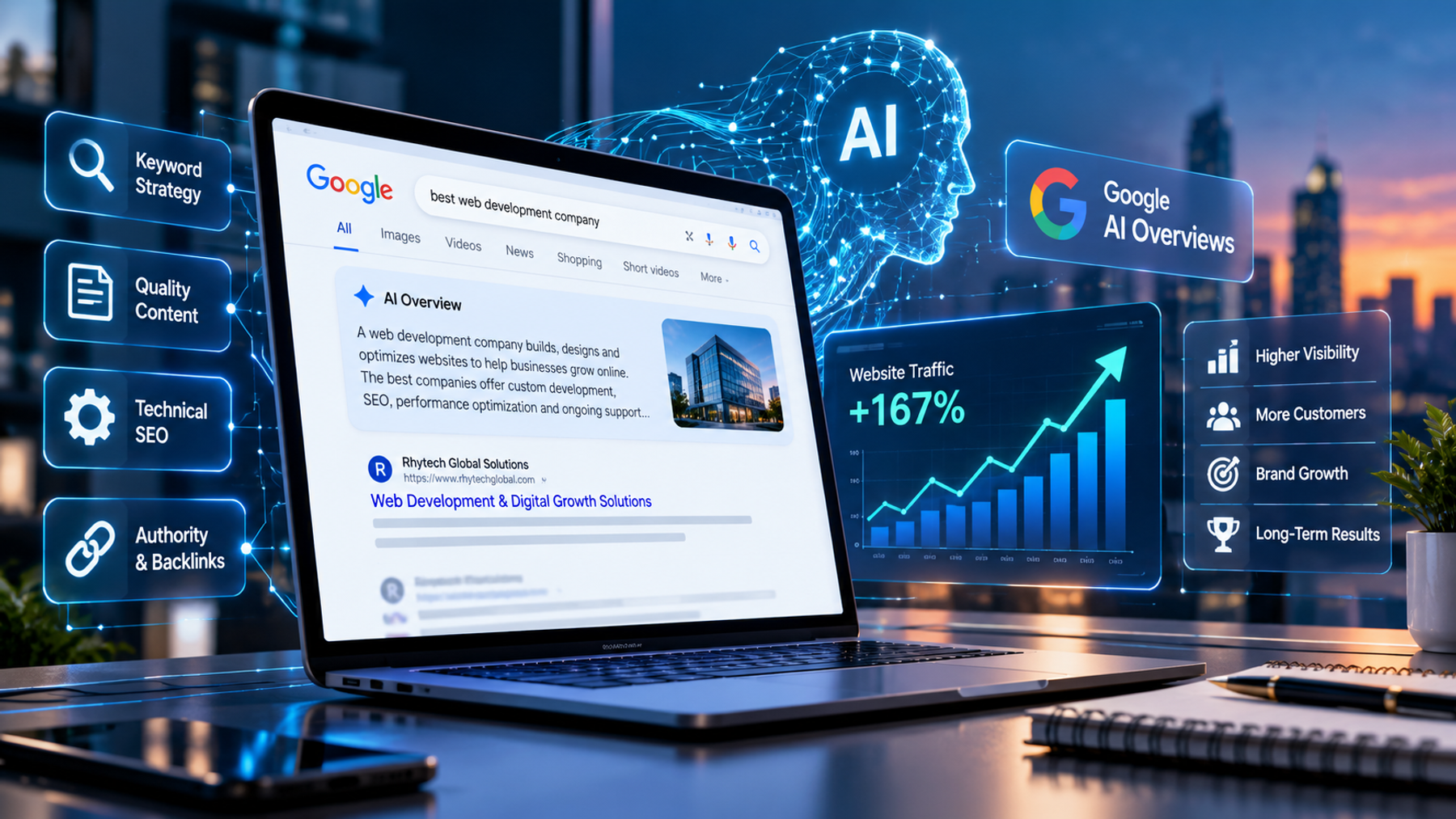
Search is also expanding beyond traditional lists of blue links. Google AI Overviews and AI Mode can help users explore questions and information through AI-powered experiences. Businesses therefore need to think about how their content serves people across different ways of searching.
The key principle is simple: make your website genuinely useful, technically accessible, and easy to understand.
1. Understand Google AI Overviews and AI-Powered Search
AI-powered search is an important development for website owners. Users can receive AI-generated summaries alongside links to sources that help them explore a topic further.
This creates a new consideration for businesses: your content should not merely repeat common information. It should provide clear explanations, useful examples, relevant experience, and information that helps readers make decisions.
How can businesses improve their chances of being discovered?
Start with these practical steps:
- Answer the main question near the beginning of each article.
- Use descriptive headings that reflect the questions readers actually ask.
- Explain complex topics in plain language.
- Include original examples, expert insights, and useful comparisons.
- Keep important information accessible to search engines.
- Maintain accurate, current information about your products and services.
- Build a clear connection between your educational content and relevant service pages.
There is no guaranteed method for appearing in an AI Overview. Google recommends sound SEO practices and valuable, distinctive content rather than shortcuts designed to manipulate AI systems.
Businesses should therefore focus on improving their overall search presence instead of chasing a supposed AI-ranking trick.
2. Focus on Search Intent Instead of Keyword Stuffing
One of the most important SEO fundamentals is understanding why someone searches for a particular phrase.
For example, someone searching for “what is technical SEO” probably wants an explanation. A person searching for “technical SEO services for my business” may be evaluating providers.
These searches are related, but they represent different needs.
A useful SEO strategy groups keywords according to intent:
Informational searches: People want to learn something.
Examples:
- What is SEO and how does it work?
- How does website speed affect SEO?
- What are Google AI Overviews?
Commercial investigation: People are comparing possible solutions.
Examples:
- Best SEO strategies for small businesses
- SEO agency versus in-house SEO
- Website redesign and SEO checklist
Transactional searches: People are closer to taking action.
Examples:
- SEO services for businesses
- Website development company
- Hire a web development agency
Create content that meets each audience's needs. Educational articles can build awareness, comparison pages can help readers evaluate options, and service pages can make it easy to enquire.
Avoid creating multiple pages that target the same intent without offering a meaningful difference. A smaller collection of strong, well-organized pages can be more useful than a large collection of repetitive articles.
3. Publish Helpful Content That Demonstrates Real Expertise
Content remains central to long-term SEO, but publishing more articles does not automatically produce better results.
Google's guidance emphasizes helpful, reliable, people-first content. An article should provide substantial value rather than simply repackage information already available elsewhere.
For businesses, this means going beyond generic definitions.
Consider an article about website development. Instead of only explaining what web development means, discuss how businesses should choose between a single-page website and a multi-page website, what affects performance, how content management works, and which technical decisions matter for future growth.
Where possible, add:
- Practical examples from real projects, with permission.
- Original screenshots, illustrations, or demonstrations.
- Clear explanations of trade-offs and limitations.
- Credible references for important factual claims.
- An identifiable author or editorial team.
- A relevant next step for readers who need additional help.
AI tools can assist with research, outlining, and editing, but human review remains important for accuracy, originality, and usefulness.
The goal is not to publish an article simply because a keyword is popular. The goal is to create the page a reader would be glad to find.
4. Strengthen Your Website's Technical SEO
Even excellent content needs a technically sound website.
Technical SEO helps search engines access and interpret your pages. It also helps visitors navigate your website without unnecessary friction.
Review the following areas regularly.
Crawlability and indexing
Check that important pages are accessible to search engines and are not accidentally blocked by robots.txt directives or noindex tags.
Submit an accurate XML sitemap through Google Search Console. Remember that submitting a sitemap helps Google discover URLs; it does not guarantee that every URL will be indexed.
Website structure and internal linking
Organize your website around clear topics and services.
For example, a technology company might structure its website around web development, digital marketing, cybersecurity, and technology consulting. Relevant blog posts can then link to the appropriate service pages.
Use descriptive internal link text so readers understand what they will find when they click.
Page titles and meta descriptions
Write a unique, descriptive title for each important page. Include the primary topic naturally and communicate why the page is relevant.
Meta descriptions should accurately summarize the page and encourage the right users to visit. Google may generate a different search snippet, so a carefully written description is useful but does not guarantee that the exact text will appear.
Canonical URLs and duplicate content
Where equivalent pages exist, use appropriate canonicalization to help consolidate signals around the preferred URL. Avoid creating unnecessary duplicate pages that provide little additional value.
Mobile usability and performance
Ensure that important content and functionality work across mobile, tablet, and desktop devices.
Review Core Web Vitals and other performance indicators, including loading performance, responsiveness, and visual stability. Compress images, avoid unnecessary scripts, and make sure the page remains usable while content loads.
Technical SEO is not a one-time task. Monitor changes as your website, content, and technology evolve.
5. Use Structured Data Correctly
Structured data is a standardized format that helps search engines interpret information on a page.
For example, a suitable article page may use Article or BlogPosting structured data to describe its headline, author, publication date, featured image, and other relevant properties.
Depending on the website and content, other schema types may also be appropriate, such as Organization, BreadcrumbList, or LocalBusiness.
A few important rules apply:
- Use a schema type that accurately represents the page.
- Make sure the markup matches the visible content.
- Include required and recommended properties where applicable.
- Validate your markup with Google's Rich Results Test or an appropriate schema validator.
- Correct errors and review warnings that matter for the intended result.
Structured data can help search engines understand a page and may make it eligible for supported search features. It does not guarantee enhanced listings, higher rankings, or inclusion in AI-generated answers.
Do not add schema simply to include as many markup types as possible. Accuracy matters more than quantity.
6. Improve Local SEO to Reach Nearby Customers
For businesses serving a specific city or region, local SEO can help connect their services with people searching nearby.
Begin by maintaining an accurate Google Business Profile where eligible. Use the correct business name, address or service area, phone number, website, categories, and operating hours.
Other useful practices include:
- Create genuinely useful location-specific service pages where appropriate.
- Keep business details consistent across important directories.
- Encourage genuine customer reviews and respond professionally.
- Add clear contact information to the website.
- Explain the areas you serve without repeating city names unnaturally.
- Use relevant LocalBusiness structured data when it accurately describes the business.
Avoid producing dozens of near-identical location pages with only the city name changed. Each location page should offer real, useful information for that audience.
Local SEO is particularly valuable when customers are looking for a provider they can contact, visit, or work with in a particular area.
7. Build Authority Through Useful Digital Relationships
Links from other websites can help people discover your content and can contribute to how search engines understand your website's reputation and relevance.
However, chasing large numbers of backlinks is not a sustainable strategy.
Instead, develop content and relationships that give others a genuine reason to reference your website.
Potential approaches include publishing original research, creating practical resources, contributing expert commentary, collaborating with relevant industry publications, and sharing useful project insights.
When discussing client projects, obtain appropriate permission and present the results accurately. Never invent testimonials, customers, case studies, or performance statistics.
Avoid paid link schemes and manipulative link-building tactics intended to influence rankings.
A relevant, trustworthy reference can be more valuable to your audience than a large number of unrelated links.
8. Measure SEO Performance With the Right Data
SEO is a long-term process, and meaningful measurement helps you understand whether your work is contributing to business goals.
Google Search Console is useful for reviewing search impressions, clicks, queries, indexed pages, and technical issues. Analytics tools can help you understand what visitors do after arriving at your website.
Monitor a balanced set of indicators:
Search visibility
- Impressions for relevant queries
- Click-through rates
- Search positions for important topics
- Indexed and eligible pages
Content engagement
- Organic landing pages
- Relevant engagement indicators
- Navigation to related service pages
- Return visits where measurable
Business outcomes
- Qualified enquiries
- Contact form submissions
- Calls or consultation requests
- Leads attributable to organic search
Do not judge a content strategy solely by total traffic. An article that attracts the right audience and generates relevant enquiries may be more valuable than one that attracts many visitors with little interest in your services.
Review performance over time, account for seasonality and changes in demand, and update content when the underlying information or user needs change.
9. A Practical 30-Day SEO Action Plan
Businesses do not need to implement every improvement at once. A structured first month can help establish a strong foundation.
Week 1: Audit the website
- Review important pages in Google Search Console.
- Check indexing, sitemap, and robots.txt settings.
- Identify broken links and unnecessary redirects.
- Review mobile usability and page performance.
- Confirm that each major service has a clear, accessible page.
Week 2: Improve key pages
- Rewrite unclear page titles and headings.
- Improve important service-page content.
- Add relevant internal links.
- Check canonical URLs and metadata.
- Validate appropriate structured data.
Week 3: Publish a useful article
- Choose a topic that matches your audience's needs.
- Research relevant search queries and competing content.
- Create a detailed, original article with a clear structure.
- Add useful visuals and descriptive image alt text.
- Link to relevant services and authoritative references.
Week 4: Measure and refine
- Verify that the new URL is accessible to search engines.
- Submit or update the sitemap if needed.
- Monitor impressions, clicks, and indexing.
- Review engagement and relevant enquiries.
- Use the findings to plan the next content update.
This is a starting framework, not a promise of ranking improvements within 30 days. SEO results depend on many factors, including competition, website history, content quality, technical health, and changes in search demand.
Common SEO Mistakes to Avoid in 2026
Even a well-designed website can underperform when its content or technical setup creates avoidable problems.
Watch out for these common mistakes:
- Keyword stuffing: Repeating the same phrase unnaturally makes content harder to read and does not create genuine value.
- Publishing generic AI-generated articles at scale: Large volumes of repetitive content can fail to meet users' needs. Automation itself is not the central issue; quality, originality, and purpose matter.
- Ignoring technical issues: Important pages that cannot be crawled or indexed may struggle to appear in search.
- Expecting guaranteed rankings: No agency, plugin, schema type, or SEO technique can legitimately guarantee a particular Google position.
- Neglecting internal links: Useful pages can be harder to discover when the website's navigation and linking structure are weak.
- Focusing only on traffic: Search visibility should ultimately support meaningful outcomes for the business.
- Chasing AI-search shortcuts: There is no universal trick that guarantees inclusion in Google AI Overviews. Strong fundamentals and useful content remain the better foundation.
Frequently Asked Questions About SEO in 2026
Is SEO still worth investing in 2026?
Yes. Search remains an important way for people to discover businesses, services, and information. A sound SEO strategy can improve discoverability over time, although results depend on the market, website, competition, and execution.
Can a website appear in Google AI Overviews?
Potentially. Google may use content from pages in its search index when generating AI-powered search experiences. There is no guaranteed inclusion method. Make content useful, accessible, accurate, and clearly organized while following Google's current guidance.
Does AI-generated content hurt SEO?
AI assistance alone does not automatically make content ineligible to rank. The important considerations are whether the content is helpful, reliable, original, accurate, and created for a legitimate purpose. Automatically producing large amounts of low-value content to manipulate rankings can violate Google's spam policies.
How long does SEO take to work?
There is no universal timeline. Some changes may be reflected relatively quickly, while meaningful organic growth can take months or longer. Competition, website authority, technical issues, and the quality of the work all influence results.
Is structured data necessary for SEO?
Structured data is not required for every page, but appropriate markup can help search engines interpret supported content and may make a page eligible for certain search enhancements. It should accurately reflect the visible page.
Should a business focus on SEO or paid advertising?
They serve different purposes. SEO can build long-term organic discoverability, while paid advertising can provide access to paid placements for targeted campaigns. The right balance depends on the business's goals, budget, competition, and timeline.
Final Thoughts: Build a Search Strategy That Lasts
SEO in 2026 is not about finding a secret formula for Google or trying to manipulate AI-generated answers. It is about making your business easier to discover, your information easier to understand, and your website more useful to the people you want to reach.
Start with a technically sound website. Publish content that answers genuine customer questions. Structure your pages clearly, use appropriate structured data, build credible digital relationships, and measure outcomes that matter to your business.
As search experiences continue to evolve, businesses that invest in quality, clarity, accessibility, and long-term usefulness will be better positioned to adapt.
Need a website and digital strategy built for sustainable growth? Rhytech Global Solutions helps businesses strengthen their digital presence through web development, technology solutions, and digital growth strategies. Explore our services to identify the right next step for your business.