Why Your Website Gets Traffic but No Leads: 10 Problems and How to Fix Them
Your website is getting visitors, your analytics dashboard shows activity, and people are landing on your pages. But there is one major problem: the enquiries, phone calls, quote requests, and sales are not coming in.
If this sounds familiar, you are not alone. Many businesses invest in website development, SEO, paid advertising, and social media marketing without building a website that effectively turns visitors into potential customers.
The problem is not always a lack of traffic. Sometimes, the website itself prevents visitors from taking the next step.
A successful business website should do more than look professional. It should communicate value, build trust, answer customer questions, and make contacting your business effortless.
In this guide, we explore 10 common reasons why a website gets traffic but no leads, along with practical website conversion optimization strategies to help improve results.
Why Does Your Website Get Traffic but No Leads?
Website traffic and lead generation are two different things. Traffic measures how many people visit your website, while lead generation measures how effectively your website encourages relevant visitors to contact your business or express interest in your services.
A website can attract thousands of visitors and still generate very few enquiries if its content does not match search intent, its pages load slowly, or its contact process creates unnecessary friction.
Before increasing your marketing budget, evaluate whether your existing website is helping visitors make decisions.
1. Your Website Does Not Clearly Explain What You Offer
When someone visits your website, they should quickly understand what your business does, who you help, and why they should choose you.
If visitors have to search through multiple pages to understand your services, many will leave before exploring further.
How to fix it
- Write a clear, benefit-focused headline on your homepage.
- Explain who your services are designed for.
- Highlight the primary problem your business solves.
- Use a visible call to action, such as "Request a Quote" or "Book a Consultation."
- Remove vague statements that do not communicate a specific benefit.
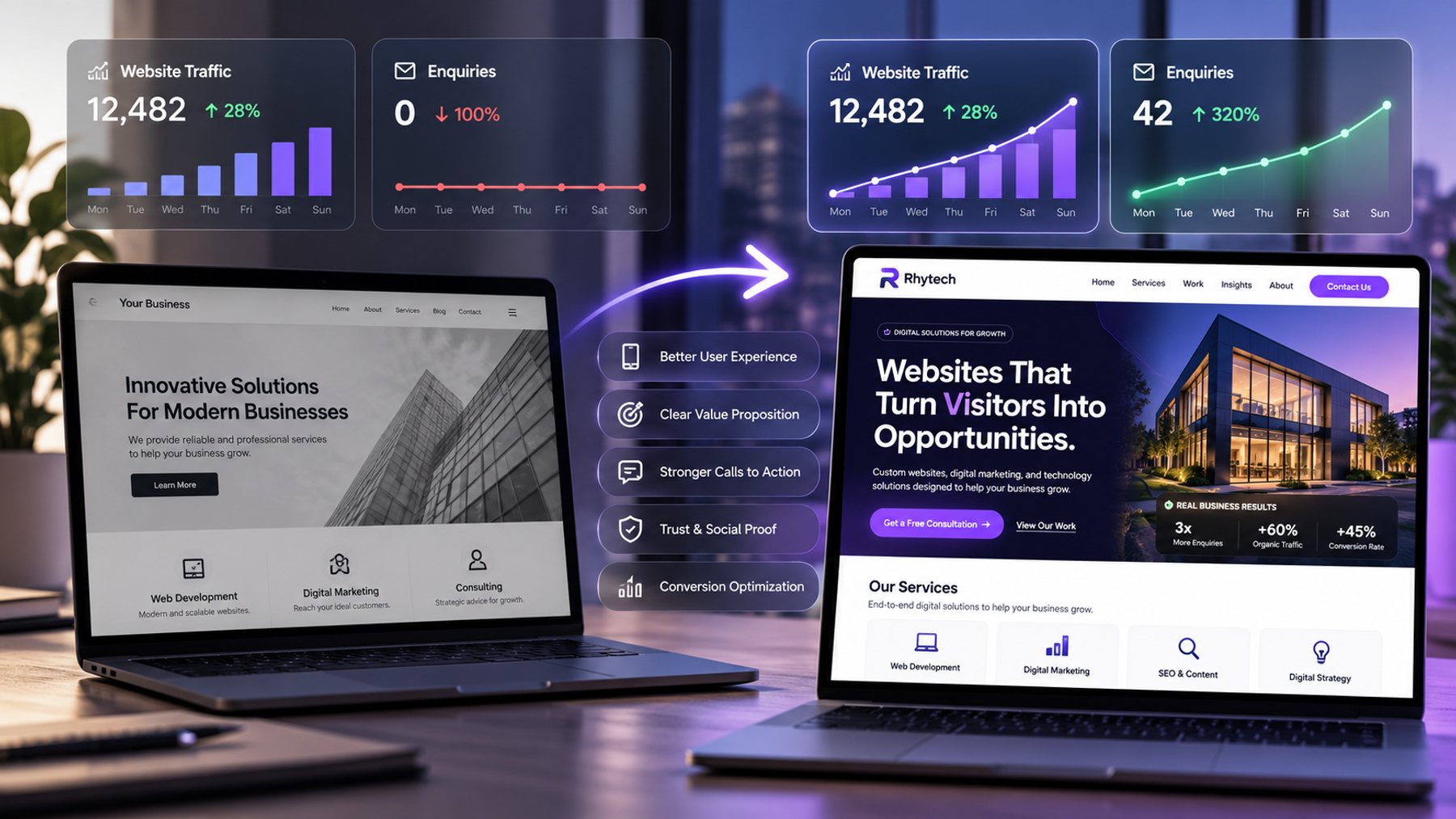
Example: Instead of saying "Innovative Digital Solutions for Modern Businesses," a web development company could say "Custom Websites Designed to Help Businesses Generate More Qualified Enquiries."
The second message tells visitors what the company does and connects the service to a business outcome.
2. Your Website Is Slow to Load
Website speed affects user experience. When pages take too long to load, visitors may abandon them before seeing your services or contacting your business.
Slow performance can result from oversized images, unnecessary scripts, inefficient code, excessive third-party tools, or poor hosting configuration.
How to fix it
- Compress images and use modern formats such as WebP or AVIF where appropriate.
- Reduce unnecessary JavaScript and third-party scripts.
- Enable caching and optimize server responses.
- Check performance on mobile devices as well as desktop computers.
- Use Google PageSpeed Insights to identify performance issues and opportunities for improvement.
Pay particular attention to Google's Core Web Vitals: Largest Contentful Paint (LCP), Interaction to Next Paint (INP), and Cumulative Layout Shift (CLS).
Improving these metrics can create a smoother user experience, although faster loading alone does not guarantee more leads.
3. Your Website Is Not Optimized for Mobile Users
Many potential customers discover businesses through mobile search, social media, and messaging apps. If your website is difficult to navigate on a phone, you may lose interested prospects.
Common mobile usability problems include tiny text, overlapping elements, difficult forms, buttons that are too small, and layouts that require horizontal scrolling.
How to fix it
- Use a responsive website design that adapts to different screen sizes.
- Make important buttons easy to tap.
- Keep headings, paragraphs, and forms readable.
- Make phone numbers clickable on mobile devices.
- Test navigation and enquiry forms on actual smartphones.
- Ensure pop-ups do not block essential content.
Mobile optimization is not simply about making a desktop website smaller. It is about making the entire experience comfortable and intuitive on a smaller screen.
4. Your Call to Action Is Weak or Difficult to Find
Visitors may be interested in your services but still leave because they do not know what to do next.
A website without clear calls to action forces users to figure out the next step themselves.
How to fix it
Use clear calls to action throughout important pages, including your homepage, service pages, landing pages, and relevant blog posts.
Examples include:
- Request a Free Consultation
- Get a Custom Quote
- Discuss Your Project
- Schedule a Discovery Call
- Contact Our Team
Choose wording that accurately reflects what happens after the visitor clicks.
Place the primary call to action where it is easy to find, and repeat it at relevant decision points. Avoid filling every section with competing buttons that distract from the main objective.
5. Your Website Does Not Build Enough Trust
Potential customers often compare several businesses before making a decision. If your website does not provide enough evidence of credibility, visitors may hesitate to submit their details.
Trust becomes particularly important when customers are considering expensive projects, long-term services, or sharing personal information.
How to fix it
Include relevant trust signals, such as:
- Genuine customer testimonials.
- Case studies that explain the problem, solution, and outcome.
- Examples of completed projects.
- Clear company information and contact details.
- Relevant certifications or professional credentials.
- Transparent service descriptions and project processes.
- A privacy policy explaining how enquiry information is handled.
Never invent reviews, client logos, certifications, or performance statistics. Authentic evidence is more valuable than exaggerated claims.
6. Your Website Attracts the Wrong Audience
Not every website visitor is a potential customer. Your website may receive traffic from people who are looking for information, searching for something unrelated, or expecting a different product or service.
For example, a business offering custom software development may receive visitors searching for free software downloads. Although those visits increase traffic, they may not contribute to sales opportunities.
How to fix it
Review your organic search queries, advertising keywords, landing pages, and referral sources.
Ask yourself:
- Are visitors searching for the services your business actually provides?
- Does the landing page answer the question behind the search?
- Are paid campaigns attracting relevant prospects?
- Are your blog articles connected to your commercial services?
- Are your location pages targeting the markets you serve?
Focus on attracting qualified traffic rather than increasing visitor numbers without considering their relevance.
A smaller audience with genuine buying intent can be more valuable than a much larger audience that has little interest in your services.
7. Your Service Pages Lack the Information Customers Need
A homepage may introduce your business, but visitors often need detailed information before they are ready to enquire.
If your service pages contain only a few generic paragraphs, potential customers may not understand what is included, how your process works, or whether your company is suitable for their needs.
How to fix it
Create dedicated pages for your main services. Each page should explain:
- The problem the service solves.
- Who the service is suitable for.
- The benefits and key deliverables.
- Your process and expected project stages.
- Relevant examples or case studies.
- Answers to common customer questions.
- A clear next step for requesting information.
For example, a website development company could have separate pages for custom website development, e-commerce development, website redesign, and ongoing website maintenance.
Dedicated service pages help visitors evaluate your offering and give search engines clearer information about the subjects your business covers.
8. Your Enquiry Forms Are Too Complicated
A visitor who is ready to contact your business may abandon the process if the form asks for too much information.
Long forms, unclear error messages, unnecessary mandatory fields, and technical failures can create friction at the exact moment a potential customer is ready to take action.
How to fix it
- Ask only for information you genuinely need at the initial enquiry stage.
- Use clear labels and helpful validation messages.
- Make forms easy to complete on mobile devices.
- Explain what happens after submission.
- Display a clear confirmation message after successful submission.
- Test email delivery and CRM integrations regularly.
For many service businesses, a short initial form requesting a name, business email or phone number, and a brief description of the requirement can be a reasonable starting point.
The right form length depends on your sales process. If a project requires detailed qualification, collect additional information when it provides a clear benefit.
9. Your Website Content Does Not Answer Customer Questions
Visitors often leave when they cannot find answers to the questions that matter to them.
They may want to understand pricing, timelines, deliverables, technical requirements, ongoing support, or the difference between competing solutions.
If your website avoids these topics entirely, customers may move to a competitor that communicates more clearly.
How to fix it
Build your content around real questions that prospective customers ask during sales conversations.
Consider publishing articles that explain:
- How to choose the right website development company.
- What affects the cost of a business website?
- How long does a website redesign take?
- What should a business prepare before starting a web development project?
- Which website platform suits different business requirements?
- How can a company measure the performance of its website?
Use blog posts to educate readers, then link naturally to relevant service pages when they are ready to explore a solution.
Helpful content can support trust and organic discovery, but it should offer genuine answers rather than simply repeating keywords.
10. You Are Not Tracking the Right Website Metrics
Without reliable measurement, it is difficult to identify why your website is failing to generate enquiries.
Page views alone cannot tell you whether visitors are contacting your business, completing forms, clicking phone numbers, or abandoning important pages.
How to fix it
Set up appropriate analytics and conversion tracking using tools such as Google Analytics 4 and Google Search Console.
Monitor metrics that relate to your business goals:
- Qualified enquiries: How many genuine prospective customers contact you?
- Conversion rate: What proportion of relevant visitors complete a desired action?
- Landing-page performance: Which pages attract visitors and contribute to enquiries?
- Traffic source: Which channels bring visitors who are more likely to become leads?
- Form completion: Where do visitors abandon the enquiry process?
- Lead quality: Which enquiries turn into meaningful sales opportunities?
For example, if a landing page receives 1,000 visits and generates 20 enquiries, its enquiry conversion rate is 2%.
That figure is a calculation, not a universal benchmark. Whether 2% is good or poor depends on the industry, traffic quality, offer, audience, and type of conversion being measured.
Use your own baseline to identify opportunities for improvement.
How to Turn Website Visitors Into Qualified Leads
Fixing individual problems is useful, but sustainable improvement requires a structured approach.
Step 1: Audit your existing website
Review page speed, mobile usability, service content, contact forms, navigation, and trust signals. Identify the issues most likely to prevent relevant visitors from enquiring.
Step 2: Understand visitor behaviour
Use analytics and available user-behaviour tools to understand where visitors arrive, which pages they explore, and where they leave. Respect user privacy and applicable consent requirements when collecting behavioural data.
Step 3: Improve high-value pages first
Start with pages that attract relevant traffic or directly support enquiries, such as your homepage, core service pages, and campaign landing pages.
Step 4: Make the next step obvious
Ensure visitors can easily request a quote, contact your team, or schedule a consultation. Remove unnecessary steps from the process.
Step 5: Test changes and measure outcomes
Change one important element at a time when practical. Compare results over a meaningful period, accounting for differences in traffic sources and visitor intent.
Do not assume that a redesign, new headline, or different button will automatically improve conversion rates. Measure the result and keep changes that produce meaningful improvements.
Should You Redesign Your Website or Optimize the Existing One?
Not every website that struggles to generate leads needs a complete redesign.
If the underlying design and technical structure are sound, improving the content, calls to action, mobile experience, or enquiry process may be sufficient.
A redesign may be worth considering when the website has persistent usability problems, outdated architecture, poor mobile responsiveness, major performance limitations, or a structure that no longer supports the business.
Before investing in a redesign, identify the problems you need to solve and define how success will be measured.
A successful website improvement project should be connected to business objectives rather than aesthetics alone.
Frequently Asked Questions
Why is my website getting traffic but no enquiries?
Common reasons include unclear messaging, irrelevant traffic, weak calls to action, poor mobile usability, slow loading, insufficient trust signals, and complicated enquiry forms. Review your visitor behaviour and conversion tracking to identify which problems affect your website.
How can I increase website leads without increasing traffic?
Improve the experience for visitors you already attract. Make your offer clearer, strengthen service pages, simplify forms, improve mobile usability, add genuine trust signals, and make contact options easier to find.
Does website speed affect lead generation?
Slow websites can frustrate visitors and make it harder for them to engage with your content. Improving performance can support a better user experience, although lead generation also depends on audience relevance, messaging, trust, and the quality of your offer.
How do I measure my website conversion rate?
Divide the number of conversions by the number of relevant visits or users in your chosen measurement period, then multiply by 100. Be consistent about your denominator and what counts as a conversion.
For example, 20 enquiries from 1,000 visits equals a 2% visit-based conversion rate.
Should I hire a web development company to fix low website conversions?
Consider professional help when technical issues, website architecture, analytics configuration, or complex user-experience problems are difficult to resolve internally. Choose a provider that investigates the causes of poor performance and explains how improvements will be evaluated.
How long does it take to improve website lead generation?
The timeline depends on the problems, the size of the website, the changes required, and the amount of relevant traffic available for evaluation. Technical fixes may be implemented quickly, while measuring the impact of broader design and conversion changes can take longer.
Final Thoughts: Your Website Should Do More Than Attract Visitors
Website traffic is only one part of online business growth. Your website also needs to help the right people understand your services, trust your business, and take the next step.
By improving page speed, mobile usability, messaging, service content, calls to action, and conversion tracking, you can identify opportunities to make your existing website more effective.
Start with the problems that create the greatest friction for your prospective customers. Measure the results, refine your approach, and focus on generating qualified enquiries rather than chasing traffic numbers alone.
Need a website that works harder for your business?
Rhytech Global Solutions helps businesses build and improve their online presence through website development and digital solutions. If your website attracts visitors but struggles to convert them into enquiries, a structured review of its performance, user experience, and lead-generation process can help identify practical next steps.
Explore Rhytech Global Solutions' services or contact the team to discuss your website requirements.